Winning an offer is pointless if it doesn’t make you money
Any tool helps you get an offer signed. Plensity tells you before you send it whether it is profitable, and saves you most of the work of preparing it.
- Selling price10.000 €
- What it costs you6.000 €
- Margin40%
- With discount −15%8.500 €
- Margin after discount29.4%
Below your minimum margin. Plensity tells you before you send it, not at the end of the quarter.
Why the margin on every offer is worth a look
more operating profit from a 1% price rise at the average S&P 1500 company. And the other way round: a 1% discount eats it just the same.
1McKinsey, 2003
of spreadsheets checked in audits had errors. A broken formula in a quote is margin that leaks away unseen.
2University of Hawaii, 2004
from signing up a company to its first quote as a PDF, with its catalogue and brand.
Our tests, October 2026
Five things Plensity does that a spreadsheet and a word processor don’t
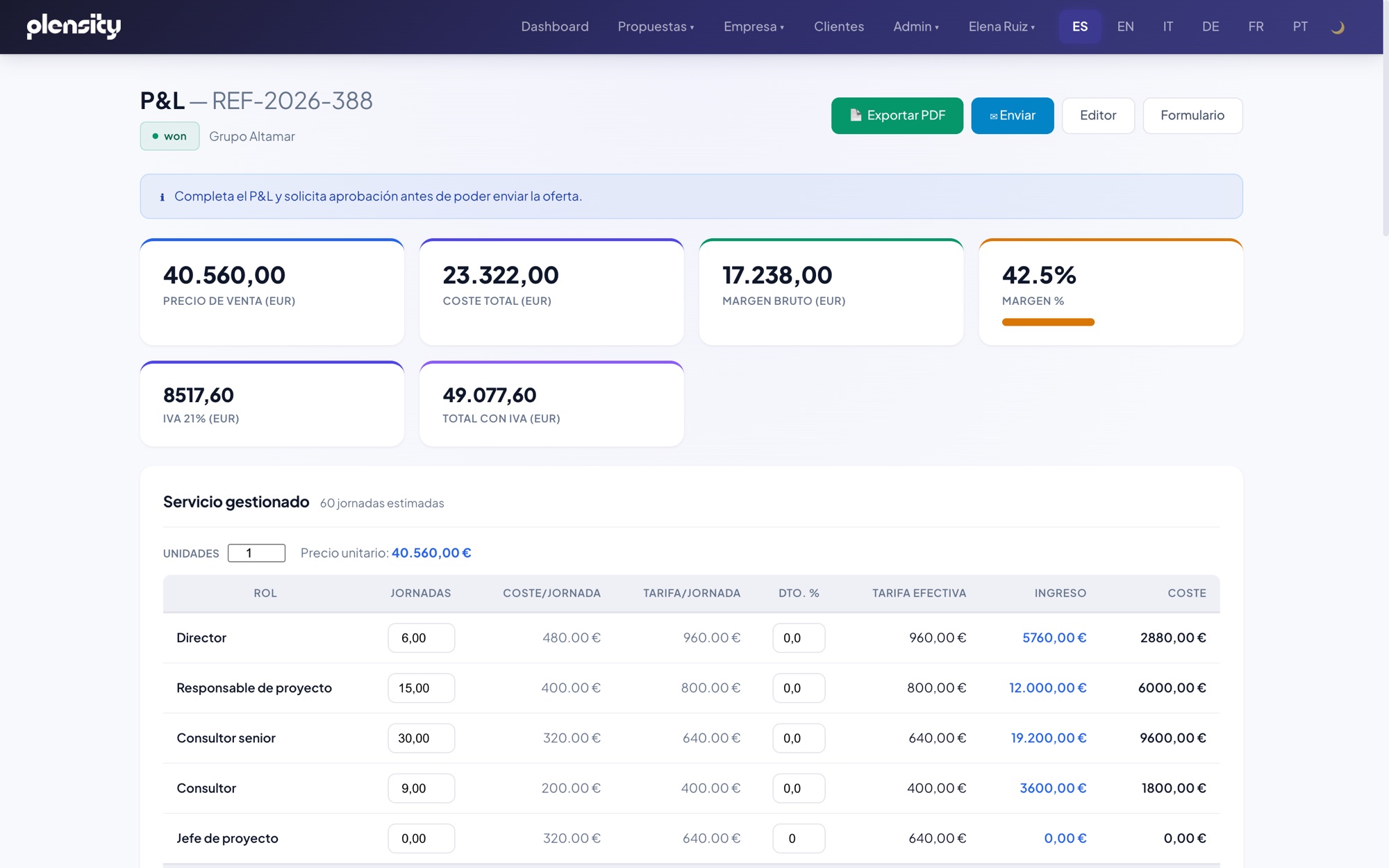
The margin, before you send
Every line carries its cost and its price. While you prepare the offer you see the margin, your minimum and your target, and the price you would need to reach it.
- Cost, price and margin of every line, instantly (Business plan).
- Minimum and recommended margin, with the price still missing to get there.
- If you work with approvals, the offer doesn’t go out until a manager signs off its numbers.
AI included, in Europe, that makes nothing up
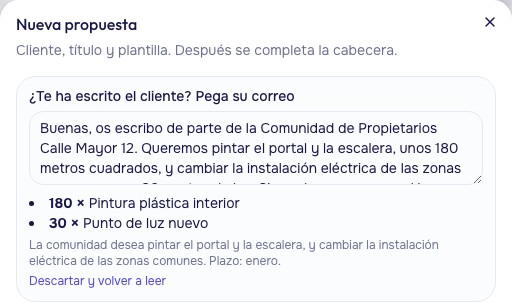
Paste the client’s email or your visit notes: Plensity’s AI picks out what they want, how much, by when and who the contact is. It runs on our EU servers and you don’t pay for any other AI.
- It only takes what is written: if something isn’t in the email, it doesn’t add it.
- It also reads your price list and builds your catalogue; you choose what goes in.
- If you connect your own AI (Claude, GPT, Gemini or Mistral), it also writes each offer to measure.
Start out speaking your industry’s language
When you sign up you choose your industry and Plensity starts with what belongs to it: a starter catalogue, field names, payment terms, warranty and the cover title. Change any of it whenever you like.
- What your industry usually sells, ready to go; you set your prices.
- Each service is charged its own way: fixed price, per day, per hour, per unit or per month.
- If you sell products, each item has a photo, data sheet, lead time and cost.
The client chooses, signs and it is kept
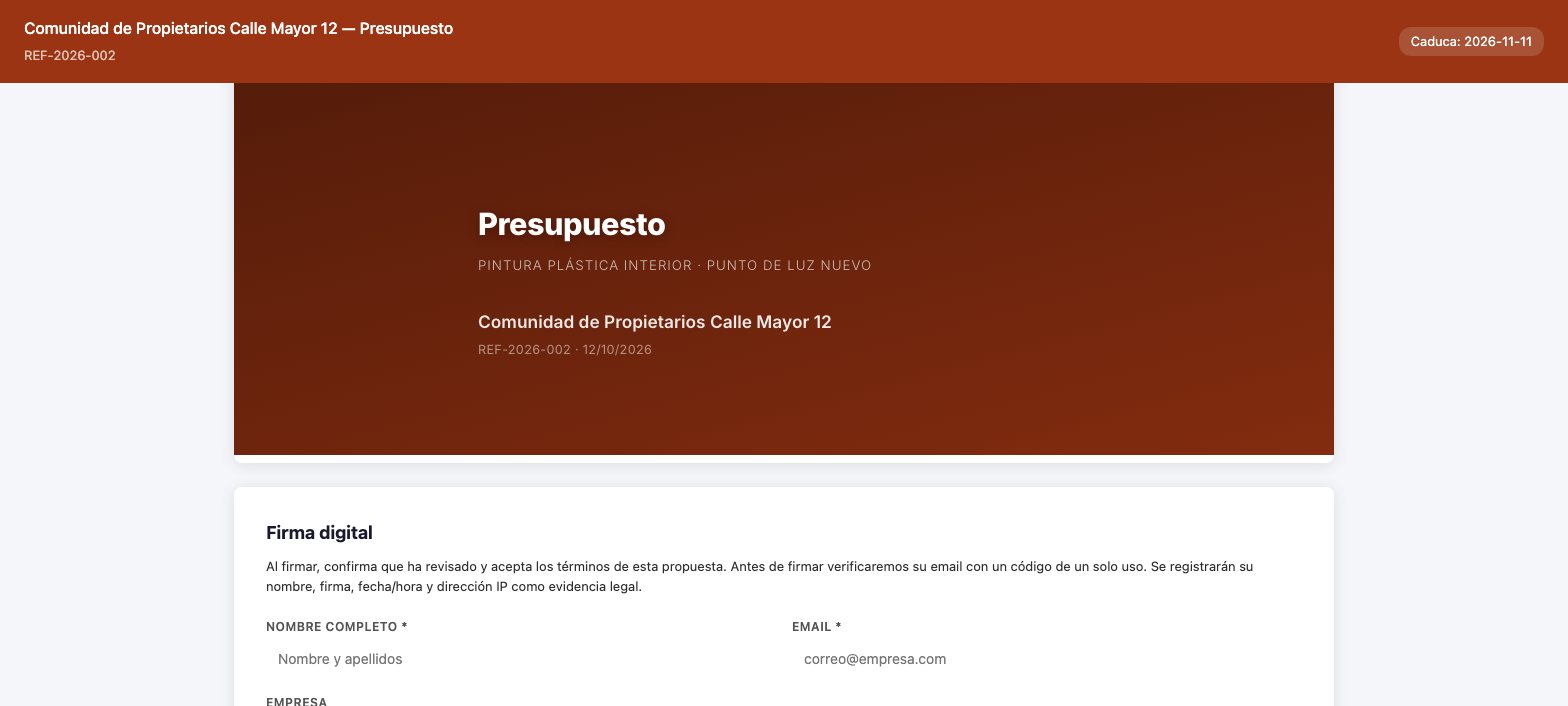
The client gets a link, not an attachment. They read it on their phone, pick the optional items they want and sign with a code sent to their email.
- Optional items are chosen when signing and the total adjusts itself.
- The exact document they signed is kept: the link, the PDF and the portal show that same version.
- If they decide not to go ahead, they can say why, and you find out.
You know what happens after you send it
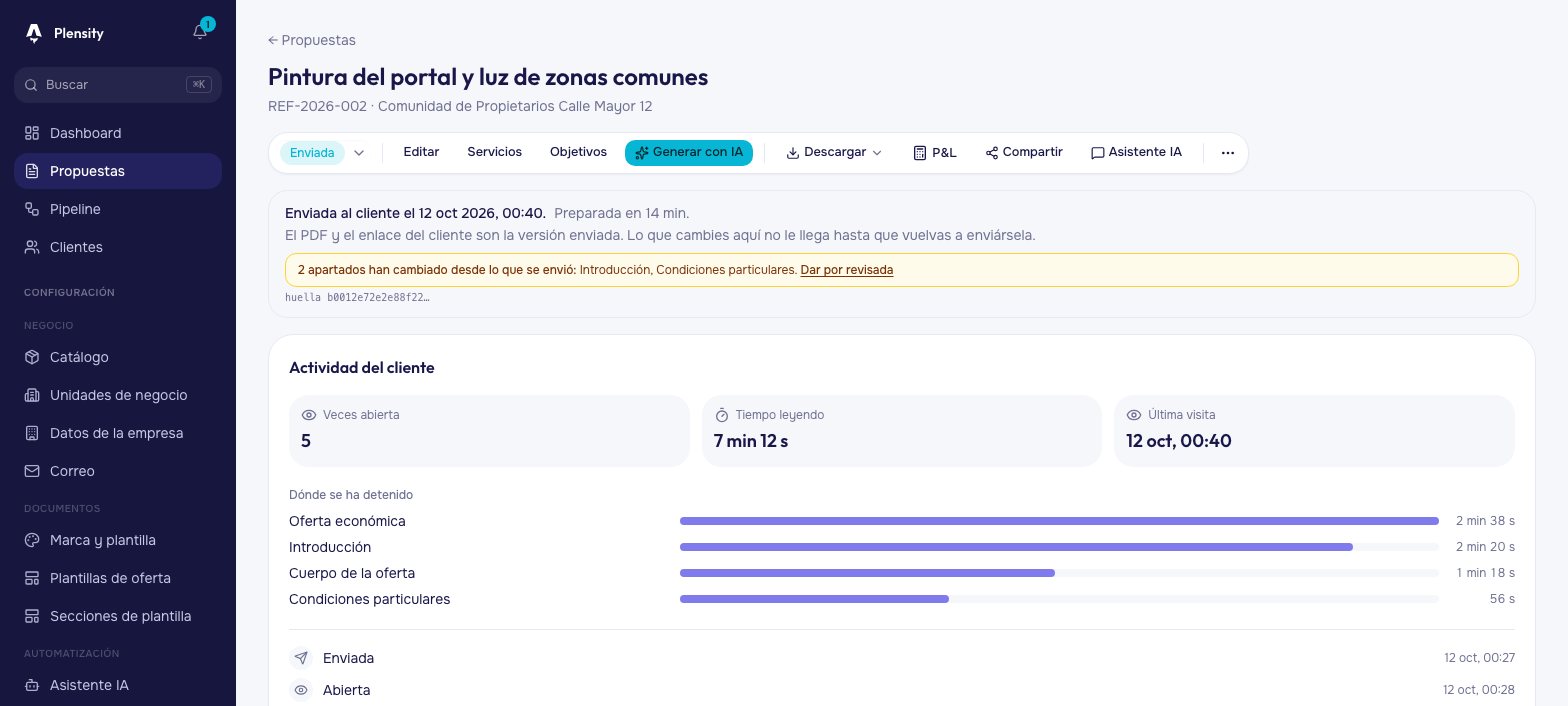
You see how many times they open the offer, how long they read it and which sections they stop at. And Plensity reminds them if they don’t look at it or it is about to expire.
- A notification as soon as they open it.
- Change tracking: what you changed since the version they received.
- The full history with date and time: sent, opened, signed.
And everything you expect from any tool, too
- Your logo, colours and cover
- Download as PDF and Word
- Documents in Spanish, English, Italian and French
- Sending from your Outlook or Gmail
- Reusable templates and sections
- Clients, proposals and results in one place
- Data in the EU and two-step verification
- API to connect your systems (Corporate plan)
Compared with what you already use
Excel and Word
Fine to start with. Once there are several of you, prices drift, totals are reconciled by hand and nobody knows which version the client received.
A document tool
They are very good at making a document look nice and get signed fast. But they don’t know what each line costs you, so they can’t tell you whether the offer makes money.
Your CRM
Plensity doesn’t replace it. The CRM knows who you sell to; Plensity prepares what you sell them, at what price and with what margin, right up to the signature.
When Plensity is not for you
If you send few offers a month and one person prepares them, Excel and Word are enough. And if what you need is contract management, complex legal workflows or qualified e-signatures, there are specialist tools for that. Plensity is for those who want to know, before sending, whether that offer will earn them a living.
Frequently asked questions
How much does it cost?+
From €19 per person per month, with a minimum of 3 people. Plensity’s AI is included: you don’t pay for any other.
How long does it take to get started?+
In our tests, under three minutes from signing up a company to its first quote as a PDF. If you paste your price list, Plensity builds your catalogue from it.
Where is my data?+
On EU infrastructure. It travels encrypted, and keys and backups are stored encrypted. We don’t train models on your offers.
What if I don’t want to use AI?+
That’s fine. The offer comes out complete without AI, with your catalogue, texts prepared for your industry, the margin and the signature.
- 1 Marn, Roegner and Zawada, “The power of pricing”, McKinsey Quarterly, 2003. mckinsey.com
- 2 Raymond R. Panko, University of Hawaii, in Computerworld, 2004. computerworld.com
Shall we show you the margin on your next offer?
14 days free, no card: try it with your prices and a real job from your company.
Try it free